
- Improvements to docs
- Add json_add_array and json_add_hash
- Add json_typeof, json_size and json_create
- Add get_savedgames_path (CLI also)
Blog
-
BooBoo 3.0.16
-
I found a reasonable controller for PS1/PS2 emulation
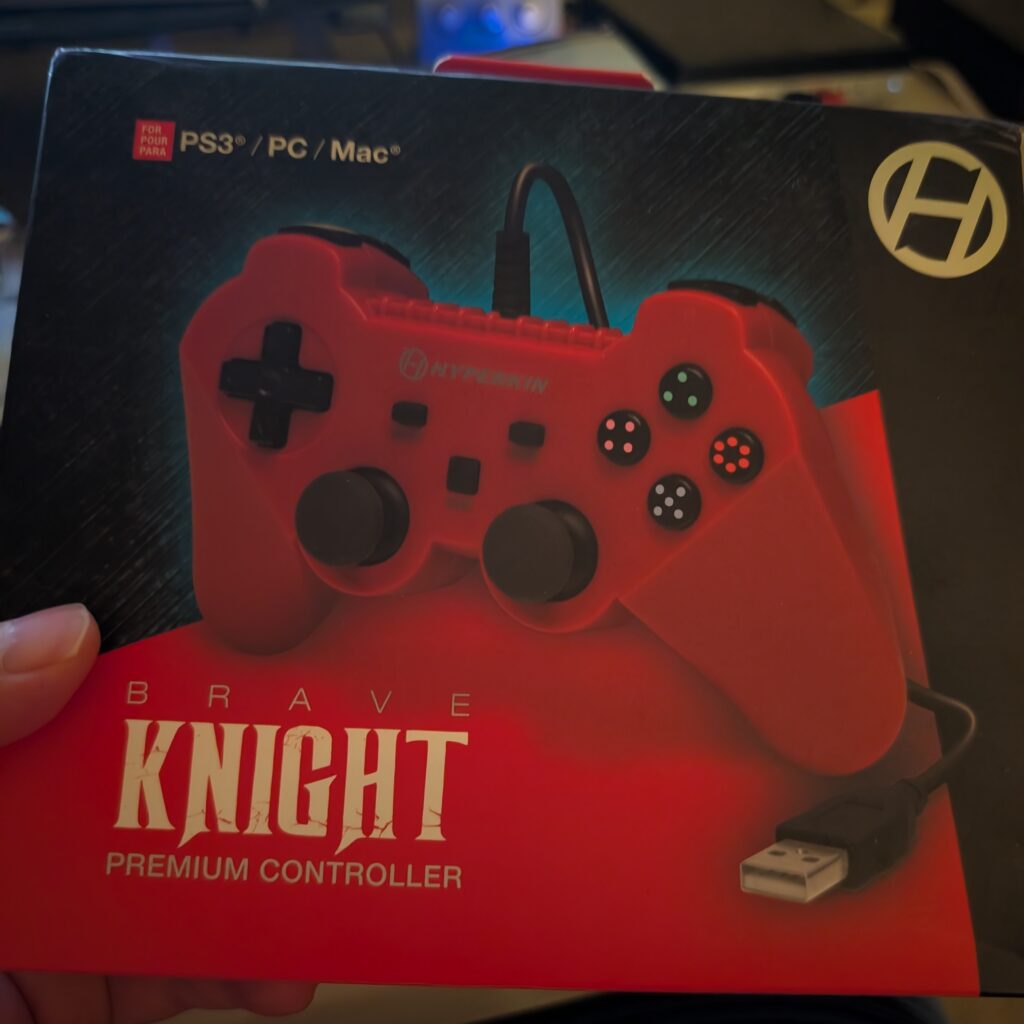
hyperkin brave knight. It’s not perfect, but nothing is. PS2/PS3 controllers don’t work properly and PS4/5 need this hack driver so this is about as good as it gets.
the l2/r2 are digital and analog buttons/motion controls don’t work, but beside that it configures automatically in DuckStation/pcsx2 and has the correct labels on the buttons.
-
The NVIDIA GT 1030 is a potato
So far every benchmark I’ve run, an Intel UHD 630 beats it by 25-30+%. I’m actually kind of surprised……………………………
EDIT: Jeeze, even the Intel HD 530 in this i5 6500 is faster than the 1030 if I remove the 1030.
-
BooBoo 3.0.15
- Support all fully supported Steam language in get_system_language
- Keep user scissor/viewport after resize
- Add get_ function for graphics settings
- Rename black_bar to letterbox
- get_args now works in BooBooCLI
- Separate fore/back colours (text_fore, text_back) text colours
- Add (widget_get_padding_*)
- Add sort and unique
- added convert_model to tools
-
convert_model will be included in next version tools
It converts ascii .x models to custom .nsm (binary Nooskewl models). In my test the zeus.x model loaded 1000 times at 23.17 seconds and .nsm version loaded 1000 at 2.9 seconds, and it’s also half the size.
-
BooBoo 3.0.14
- Standalone docs
- draw_3d named draw_vertex_buffer
- draw_3d/draw_model/draw_billboard no longer mess with the depth buffer
- file_read_line now includes newline, add file_read/write_byte
- Add string_set_char_at
- vector_clear and map_clear can clear multiple containers
-
the new draw_vertex_buffer
Can draw in 2d also. Actually the difference is draw_3d (removed) manages the depth buffer but draw_vertex_buffer doesn’t. So if you’re drawing 3d geometry you’ll want to enable/disable depth write and test as required.
-
BooBoo benchmarking
EDIT: here’s a better benchmark. I’m getting 3 million tris at 60 FPS. EDIT it’s 2 million textured with alpha testing
This is a 75px triangle (running at 1280×720 default window) benchmark to see how your system compares to PS2 running BooBoo. You should probably texture the triangle to get a more accurate result. I get about 900,000 textured and 1.2 million untextured per frame.
EDIT: PlayStation 2 claims max 16 million per second, that’s 266,000 per frame.
var tris = tris 3000000 var font = font (font_load "font.ttf" 32 1) var vertex_buffer call load_vb set_projection (identity 4) (ortho 0 640 360 0) function load_vb { var verts faces colours normals texcoords var i for i 0 (< i tris) 1 next var x y = x (rand 0 1280) = y (rand 0 720) vector_add verts x y 0 vector_add verts (+ x 6) y 0 vector_add verts x (+ y 6) 0 vector_add faces (+ (* i 3) 0) (+ (* i 3) 1) (+ (* i 3) 2) :next = vertex_buffer (create_vertex_buffer (@ verts) (@ faces) (@ colours) (@ normals) (@ texcoords) tris TRUE) vector_clear verts vector_clear faces } function draw { enable_depth_test TRUE enable_depth_write TRUE draw_vertex_buffer vertex_buffer enable_depth_test FALSE enable_depth_write FALSE font_draw font 255 255 0 255 (string_format "%(.0f)" tris) 5 50 } function event type a b c d { if (== type EVENT_KEY_DOWN) key if (== a KEY_UP) up (== a KEY_DOWN) down = tris (+ tris 100000) destroy_vertex_buffer vertex_buffer call load_vb :up if (> tris 100000) go = tris (- tris 100000) destroy_vertex_buffer vertex_buffer call load_vb :go :down :key } -
BooBoo 3.0.13
- Add VBOs for create_vertex_buffer (optional last boolean parameter) for greater speed
- Fix winding order of faces in lit3d, 3dcube and DOOMED examples now that we are culling backfaces
- vector_clear now free memory not just vec.clear()
-
VBO backed vertex buffers
The vertex buffers in BooBoo 3.0.12 are just a streamlined format, they’re quite a lot faster but the next version will have a boolean to create a VBO. I tested it and I get 900,000 tris per frame, up from 600,000.
EDIT: the playstation 2 can do about 250-275,000. I’m sure with programmable shaders though you can do a lot more than a PS2.